Hunza Valley Travel Guide 2026: Everything You Need to Know

Pakistan Locals Team
19 July 2026 · 7 min read
At a glance
- Location
- Hunza Valley
- Region
- Gilgit-Baltistan
- Best time
- Blossom in late March to April, clear peaks May to October, and September to October for the best of everything
- Duration
- 5 to 10 days
- Altitude
- 2,438 m at Karimabad, up to 4,733 m at Khunjerab Pass
If you only see one place in Pakistan, a lot of people will tell you to make it Hunza. And honestly, they have a point. This narrow valley in the far north of Gilgit-Baltistan gives you seven-thousand-metre peaks like Rakaposhi looming over apricot orchards, a 700-year-old fort on a ridge, a lake so blue it looks fake, and some of the warmest people you will meet anywhere. This guide is the stuff we would actually tell a friend before they went: when to go, how to get there without stress, what is worth your time, and the small practical things that trip everyone up.
First, get your bearings
"Hunza" is the whole valley, not one town. It runs along the Hunza River north of Gilgit, all the way up to the Chinese border at Khunjerab. People usually base themselves in Karimabad (also called Central Hunza), which sits around 2,438 m with Rakaposhi and the Ladyfinger peak staring right at you. Upper Hunza, or Gojal, is the stretch beyond Attabad Lake toward Passu, Sost and the border. Wherever you sleep, Karimabad is your natural hub.
When to go
Hunza has a short season, and honestly each part of it feels like a different trip.
- Blossom (mid-March to April). The cherry and apricot trees go pink and white, and the whole valley looks like a postcard. It is stunning, but the bloom only lasts around ten days, so timing is a bit of a gamble. High passes are still shut.
- Summer (May to August). Everything is open, Khunjerab included. July and August get busy with domestic tourists, so book your rooms early. Mausam is warm by day and pleasant at night.
- Autumn (September to October). If you ask people who keep going back, this is the one. Stable weather, the sharpest mountain views of the year, fewer crowds, and the poplars turning gold. Bakamal.
- Winter (November to February). Snowy and quiet and beautiful, but a lot of guesthouses close and roads can shut. Only if you know what you are signing up for.
How to actually get there
Two ways up. The quick one is to fly Islamabad to Gilgit (about an hour), then drive 2 to 3 hours north to Karimabad. The flight is gorgeous but very moody about weather, so leave yourself a spare day and do not book anything tight on the far end.
The other way is the Karakoram Highway, and it is a trip in itself. Around 18 to 20 hours from Islamabad, usually split over two days, either via Naran and Babusar (summer only) or the year-round Besham route. Private cars, Hiace vans, or the reliable NATCO and Faisal Movers coaches all run up to Gilgit. Take the road at least one way if you can. It is half the experience.
What is worth your time
- Baltit Fort. The 700-year-old seat of the Mir of Hunza, beautifully restored by the Aga Khan Trust for Culture. It is the most photographed building in the mountains for a reason. Go early, before the tour groups roll in.
- Altit Fort. Even older, with a lovely restored royal garden and a proper old-village walk below it. Quieter than Baltit and worth the hour.
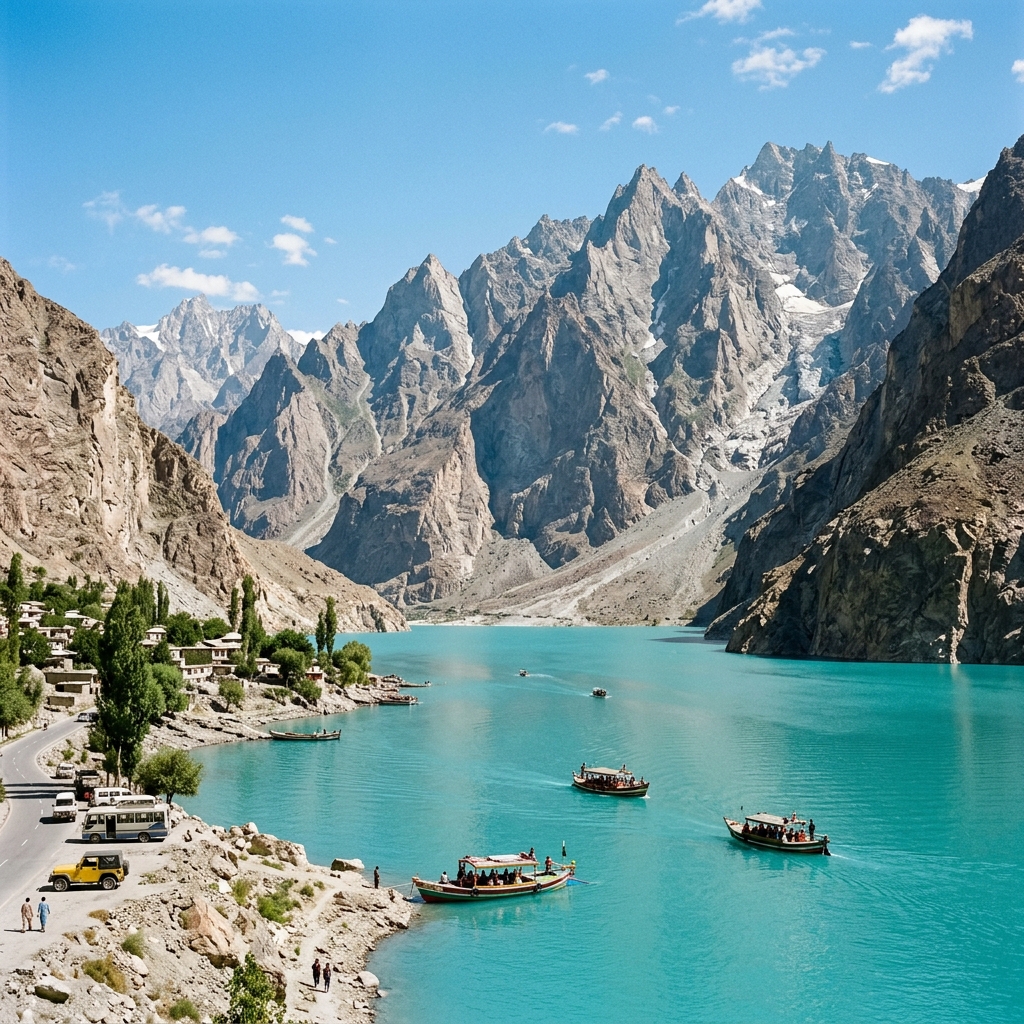
- Attabad Lake. That unreal turquoise lake, formed when a landslide dammed the river back in 2010. Boats and jet-skis now, and it is the photo everyone wants.
- Passu Cones. The jagged saw-tooth peaks that basically became the logo of northern Pakistan. Pair them with the wobbly Hussaini suspension bridge if your nerves can take it.
- Eagle's Nest at Duikar. The classic sunrise and sunset spot above Karimabad, with a full sweep of Rakaposhi, Diran, Golden Peak and Ladyfinger. Worth the early alarm.
- Hopper Glacier. A great half-day across the river into Nagar, where the glacier pours down between villages.
- Khunjerab Pass (4,733 m). The highest paved border crossing in the world, right on the China frontier. It is a long day from Karimabad, but standing up there is something else. Take it slow at that altitude.
How many days you really need
If you fly both ways, three days gets you the forts, Attabad, Passu and one sunrise. Give it five or six and you can add Khunjerab and Hopper without rushing. With seven to ten days you can pair Hunza with Skardu and Deosai, or go deep into the Gojal valleys and Naltar. Do not try to cram Khunjerab and Attabad into the same day. You will just be tired and take worse photos.
Where to stay
Karimabad has the most choice, from simple family guesthouses to mid-range hotels with Rakaposhi-view terraces and a couple of proper lodges. For the best sunrise, sleep up at Duikar (Eagle's Nest). For peace and the Passu Cones on your doorstep, base in Gulmit or Passu. In July and August, book ahead, and the same goes for blossom week.
Where and what to eat
Hunza food is its own thing, and it is genuinely healthy: apricot oil, buckwheat, walnuts, mulberries, mountain greens. You have to try chapshuro (a meat-filled bread that is basically Hunza's answer to a calzone), plus harissa and apricot soup. In Karimabad, Café de Hunza is famous for its walnut cake and coffee, the Hunza Food Pavilion on the path up to Baltit does the traditional stuff, and Hidden Paradise is loved for organic home cooking. And do have the apricot and mulberry juice. Ek dum fresh.
What it costs
Hunza is kind to your wallet. Backpackers get by on under PKR 5,000 a day with a guesthouse room, local food and shared transport. A comfortable trip with a private car for day trips runs more like PKR 8,000 to 15,000 a day per person. An all-in 5 to 6 day package from Islamabad usually lands somewhere around PKR 35,000 to 50,000 per person depending on group size, not counting flights.
Permits, SIMs and cash (the boring but important bit)
No permit or NOC is needed for Hunza or even Khunjerab, for locals or foreigners. Just carry your passport or CNIC for the checkpoints along the highway.
Now the thing nobody warns you about: your normal SIM will die up here. In the high valleys, only SCOM works properly, and Jazz or Zong basically give up on most of the Karakoram Highway. Telenor has the widest coverage across the north and is the safest single SIM to carry. Zong and SCOM both do fine in Karimabad, and SCOM reaches furthest into the most remote upper valleys. You cannot buy an SCOM SIM at the airport, so pick one up in Gilgit, Karimabad or Skardu with your passport and visa copy. Download your offline maps before you leave Islamabad, and carry enough cash for the whole leg, because ATMs basically stop after Gilgit.
What to pack
Layers, all year. Even summer nights are cool, and a windproof or rain jacket earns its place. Bring sturdy shoes, strong sunblock and sunglasses (the sun at altitude is no joke), a power bank, and cash. For spring and autumn, throw in a real down layer for cold mornings and the Khunjerab day.
When you are ready to actually book something in the north, browse experiences and stays in Hunza or see everything across Gilgit-Baltistan on Pakistan Locals. Planning the wider trip? Read our month-by-month guide to northern Pakistan and our Skardu guide next.
Written and fact-checked by the Pakistan Locals editorial team, with local hosts and guides who host and guide in Hunza. Last updated August 2026. Prices, flights and road conditions change with the season, so confirm the details that matter before you travel.
Sources and further reading
Ready to explore Pakistan with local hosts? Browse trips and experiences on Pakistan Locals, and if you live in the area you can list your own experience or stay. Read our Attabad Lake guide and Karakoram Highway road trip next.
Questions people ask
What is the best time to visit Hunza?+
Blossom comes late March into April, the peaks are clearest May to October, and September and October give you the best of everything.
How do you get to Hunza from Islamabad?+
Fly to Gilgit in about an hour when the weather allows, then drive two to three hours, or take the Karakoram Highway overland in eighteen to twenty hours.
Which SIM and network works best in Hunza?+
Telenor has the widest coverage across the north and is the safest single SIM to carry. Zong is fine in Karimabad, and SCOM reaches furthest into the most remote upper valleys.
Do you need a permit for Hunza or Khunjerab Pass?+
No permit for Hunza. Khunjerab Pass sits inside Khunjerab National Park, where you pay a park entry fee at the gate.
Pakistan Locals Team
The Pakistan Locals editorial team writes practical, on-the-ground travel guides to Pakistan, researched and fact-checked in consultation with our network of local hosts and guides.